
Unstoppable Discipleship
by Lisa Coleman
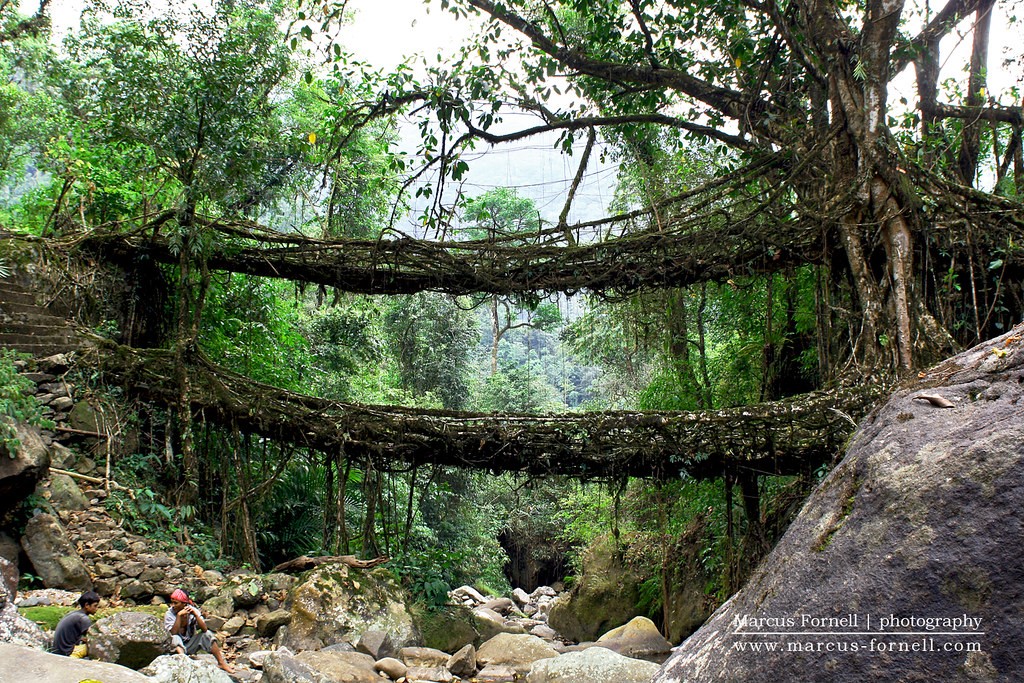
Meghalaya in northwest India is arguably the wettest place on earth. The mile-high mountain range boasts the world record for rain with an annual accumulation that once topped 82 feet. Staying dry, of course, is a battle, but it’s actually not the biggest challenge caused by constant rain. Over the years, the rain has turned creeks into valleys and large gorges that now crisscross the rainforest floor.
Most of the rain falls during the summer monsoons. In this season, gentle creeks become raging rivers, impassible on foot. An extravagant commuter bridge system is needed to keep villages connected to one another. But normal bridge concepts are not an option. Because of the rainfall, wooden bridges would quickly collapse to erosion. Concrete and steel are not available alternatives in such a remote region. So, members of the Khasis tribe have crafted an ingenious solution.
On a riverbank, a small strangler tree is planted. Once the tree is large enough, roots are extracted from the ground. These roots are meticulously cultivated to grow to a sufficient length and coaxed across the gorge. Once on the other side, the roots are sewn into the opposing riverbank, take hold, and grow thick. Roots from other strangler trees are enticed across the gorge and interwoven into a walkway strong enough to support pedestrian traffic. Mud is fashioned into pavement and the bridge is open for business. They become living bridges, some of which have lasted for centuries. The largest, Umshiang Double Decker Root Bridge, is reported to be more than a mile long and stands at a height of 2400 feet.
As you might imagine, the growth of hundreds of roots across wide spans is a slow process. It is so slow in fact that a bridge cannot be completed in a single lifetime. The work of the project must be passed on to the next generation. Children are taught from a very young age how to care for the strangler tree and direct its growth.
Major Dalton, “The Generational Bridge”
The difficulty of getting from here to there has never been so fully illustrated as the story of Paul’s journey through the book of Acts. In Chapter 28 we see Paul overcome great obstacles and connect full circle back to his homeland, Rome, for his final work. God made a way when there was seemingly no way for the Gospel to continue spreading to Rome and beyond. The living bridges of Meghalaya illustrate the tenacity, creativity, and hard work required to overcome challenging realities that threaten critical outcomes. They also remind us of the work given to the next generation to continue. Paul worked with what he had to work with, who he was given to work alongside, and where he was sent in order to obey and serve God. He was the human bridge God used to spread the Gospel to Rome and then internationally from its regional confines. Join us for this last week in our study of Acts.
Note: Also, please mark your calendars and plan to join us on October 24th as we launch into our next exciting study entitled TRANSFORMED: Knowing & Doing God’s Will. It will be an in-depth study of the Book or Romans and I know you will enjoy it.
* * * * *
You can download the Bible study materials for this session for your personal use and watch the Zoom video of the in-class session by following the links below:
PowerPoint Slides
PDF File
Video
Follow this link to find other studies in the INpowered Discipleship series.
